
Painful knee during downhill running? A runner's knee case
How downhill could be triggering your Runner's knee (Patellofemoral Pain Syndrome)
Patellofemoral Pain Syndrome (PFPS), commonly known as ‘runner’s knee’, is a prevalent overuse injury that regularly results in relapses after returning to running. Downhill running is a major risk factor in the incidence of patellofemoral pain. Research has shown that patellofemoral stress is a lot higher in downhill running compared to flat-ground and uphill running (French et al. 2018). Unfortunately, we can’t always avoid a hill when the terrain is various. Therefore, learning how to run downhill has its place in the return-to-sports trajectory of a client with patellofemoral pain.
Running gait anlysis software to detect compensations
To address this issue, a thorough running gait analysis using specialized software can be invaluable. Running gait analysis software allows us to assess the runner’s technique and identify areas for improvement, especially in downhill running. By analyzing the data, we can pinpoint the specific areas where the runner struggles.
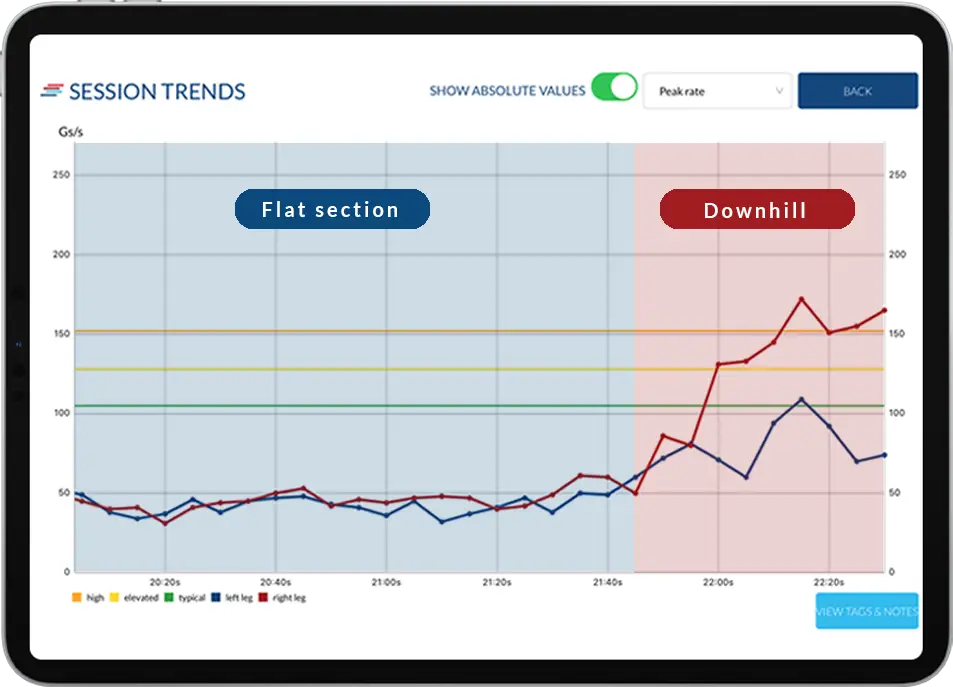
Can you see in the graph above how the runner struggles to attenuate the shock (i.e., absorb the load) on his injured (right) leg when he runs down the hill? This is visualized by the red line.
"Real-World Running Analysis Data, Including Impact Assessment During Downhill Running, Provides Invaluable Insights Into Pain And Injury, Empowering Us To Be Better Prepared For Future Challenges."
By incorporating targeted interventions based on gait analysis findings, we can work on improving the runner’s descent technique. This will be one of the key factors in reassuring the runner that there are habits they can change to mitigate the risk of PFPS and increase their chances of succeeding in their return to running.
Remember, addressing the mechanics of downhill running is just one aspect of a comprehensive rehabilitation plan. Combining this with appropriate exercises, strength training, and a gradual return-to-running program tailored to the individual’s needs can lead to better outcomes and reduced chances of PFPS relapse.