We’ve all experienced that moment during a grueling workout or race when fatigue begins to set in. It’s when the “man with the hammer” looms closer, and suddenly, every movement requires extra effort. Our arms strain to pull a bit harder, and lifting our knees becomes a challenge. This fatigue not only affects our energy levels but also has a profound impact on our running technique (biomechanics) and how our bodies bear the load. Interestingly, this response to fatigue is highly individual and can ultimately determine whether we emerge victorious or fall short in a race. In this blog post, we aim to shed light on the changes in running technique (biomechanics) that occur during maximal aerobic speed interval training, offering you a real-life example to illustrate these transformations.
Training protocol
To provide you with a clearer understanding of the workout, let’s start with the concept of maximal aerobic speed (MAS). MAS is essentially the lowest running speed at which an athlete reaches their maximum oxygen uptake (VO2 max), often referred to as the velocity at VO2 max (vVO2 max). Endurance and team sports commonly employ MAS workouts to enhance an athlete’s aerobic power. There are various methods to determine your MAS, with this particular case relying on the 1200m shuttle run.
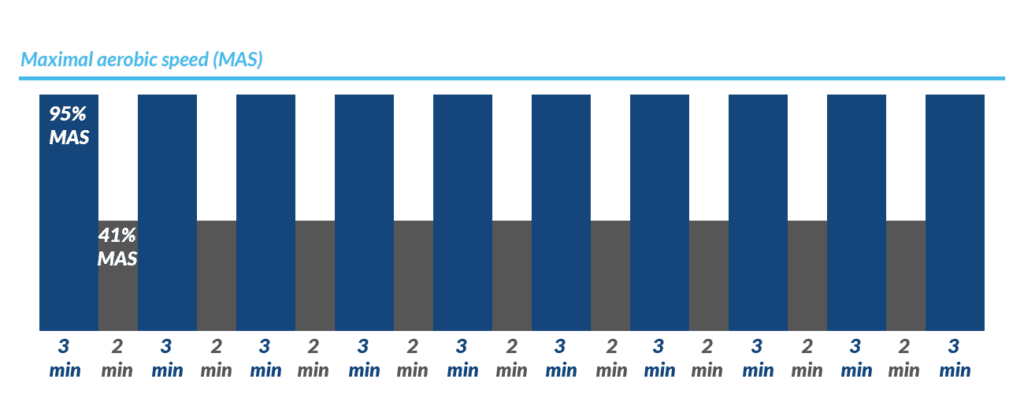
In this particular case, the athlete performed an interval session consisting of 10 repetitions. Each repetition involved running at a speed of 16 km/h, which corresponds to 95% of their MAS. Following each 3-minute interval, the athlete took a 2-minute recovery period at a reduced speed of 7 km/h, equivalent to 41% of their MAS. It’s worth noting that this training intensity zone is highly demanding, and maintaining optimal running quality throughout the session becomes crucial.
Running quality - fast intervals
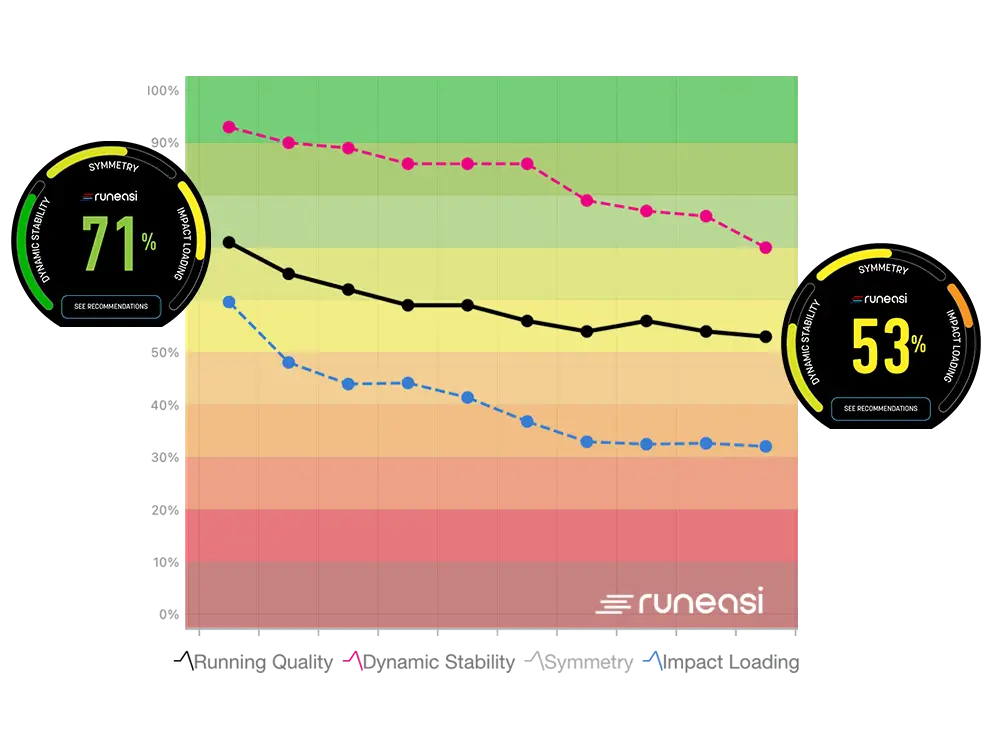
A noticeable trend emerges—the runner’s ability to maintain good quality appears to be compromised, resulting in a significant decrease in both stability and impact loading scores. Specifically, we observe a drop of approximately ±23% in stability scores and approximately ±27% in impact loading scores. These findings shed light on the challenges faced by the runner in sustaining their optimal form and managing the impact forces associated with the intense training intensity. It emphasizes the importance of addressing stability-related factors to enhance running performance and reduce the risk of injuries.
Running quality - recovery intervals
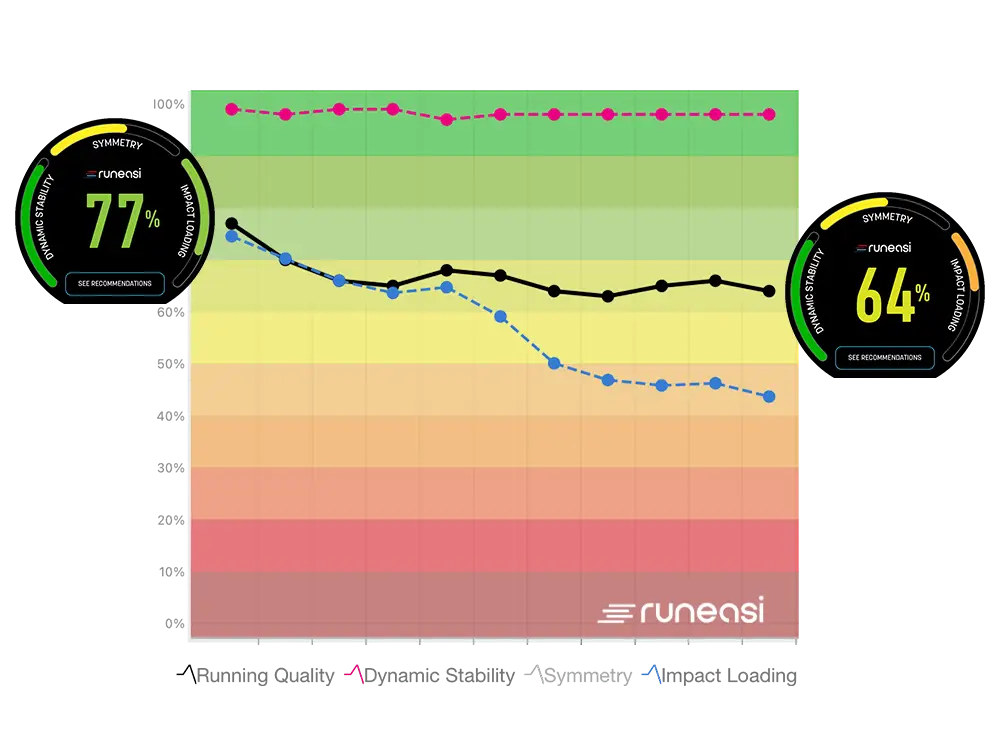
Fatigue affects not only fast running but also recovery intervals, compromising performance in both aspects. The graph reveals that the runner maintains good general pelvic stability throughout the intervals, but there are noticeable discrepancies in impact loading. These disparities primarily stem from diminished shock-absorbing abilities following intense intervals. Fatigue in the muscles responsible for absorbing shocks can impair their function.
"Utilizing biomechanical running data offers valuable insights for tailoring interval training to individual runners."
How can you utilize this data?
- Assess your running quality and identify the weakest links during high(er) speed intervals.
- Utilize the gathered data to devise a strategy for improving the weakest link.
- Evaluate susceptibility to biomechanical fatigue by comparing data from the beginning and end of the workout.
- Customize the training build-up for the next interval workout, including determining the appropriate number of repetitions and optimal recovery periods based on individualized data.
Preparing your runner for a next challenge?
Speak to a member of our Runeasi team, and learn how Runeasi can help you achieve your runner’s individual goals.