
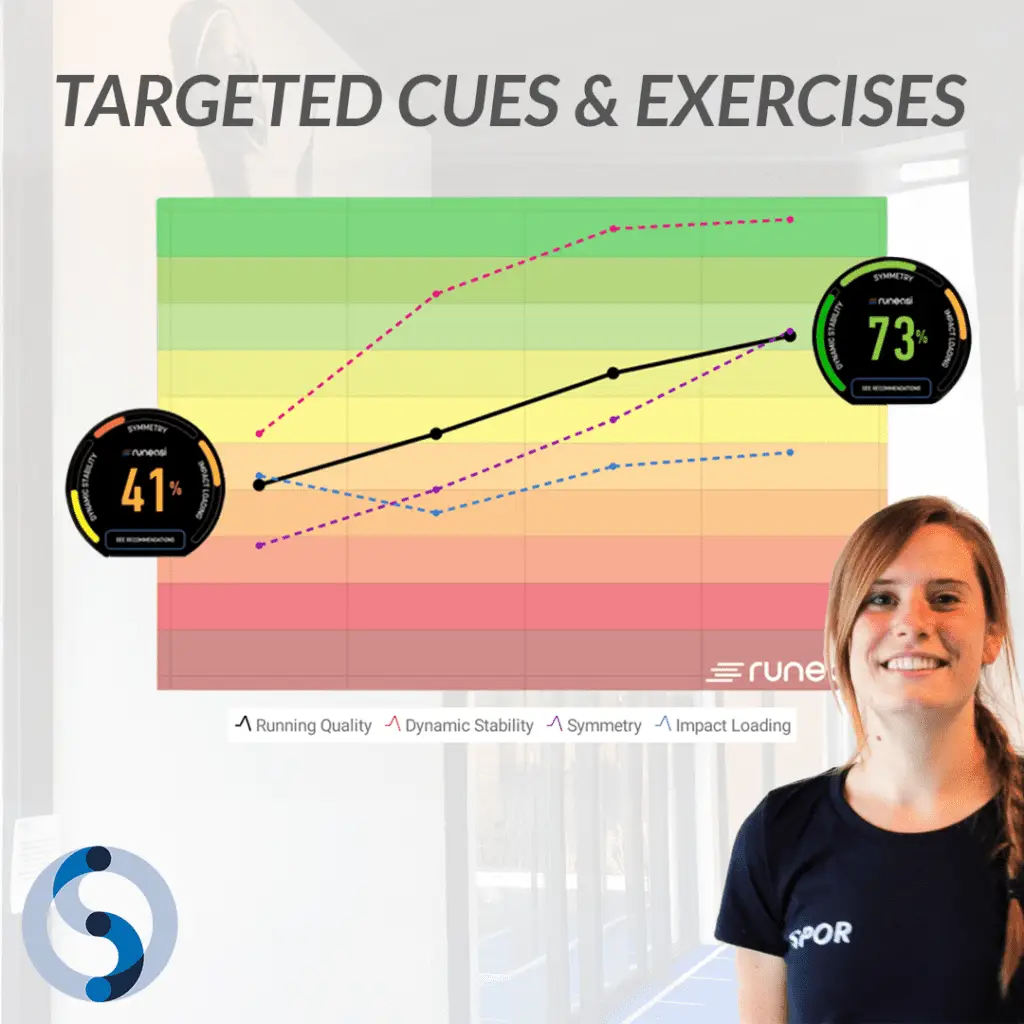
Dealing with running injuries is a common challenge for both runner and physiotherapist. It’s crucial to address and improve the contributing factors to minimize recurrence rate. In this blog post, we will dive into the running data of a runner who successfully overcame pain in the tibialis posterior muscle and a history of bilateral shin splints with the guidance of Esther Vanwijck, a skilled physiotherapist at SPOR Mechelen. Esther utilized objective running data to track progress and made tailored adjustments to the training plan over a period of three months, resulting in significant improvement for the runner. This story serves as an excellent example for physiotherapists and health-care providers on how to use data-driven insights to optimize training plans and prevent running injuries for their clients.
Identified weakest links with runeasi analysis
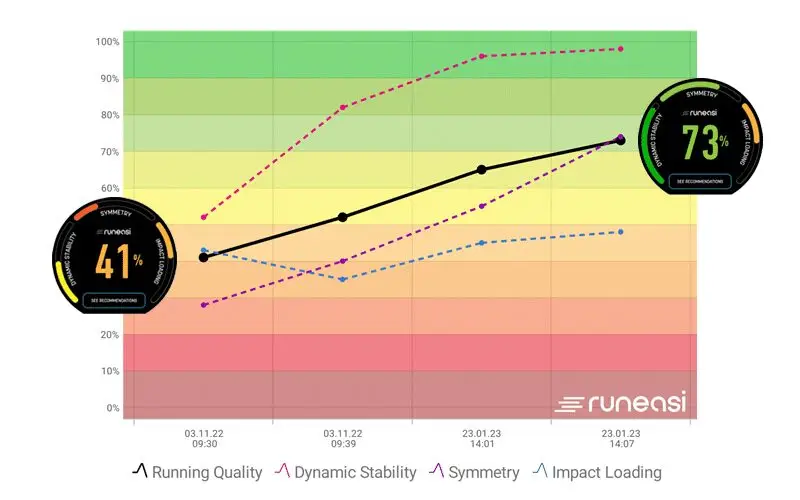
During the initial running assessment on a treadmill (November 3rd), an overall running quality score of 41% was recorded. The data analysis by Runeasi revealed a noticeable asymmetry between the left and right leg in controlling the side-to-side hip movements, indicating a lack of stability in the kinetic chain during running. Based on this finding, Esther conducted a second recording, where the athlete was given a cue to minimize lateral hip movements while running. The athlete responded well to the cue, resulting in an overall improvement to 52%. As shown in the first graph, this cue not only improved the symmetry score (+12%), but it also improved the dynamic stability score impressively (+30%)

From runeasi analysis to a targeted exercise program
Over the following weeks, the athlete underwent a program provided by Esther, which targeted unilateral stability. The program’s initial phase involved doing various foot core exercises that were based on recent research by Ulisses T. Taddei and colleagues, as well as exercises from Jay Dicharry’s work. In addition, the program included static hip stability exercises, such as the static hip lock exercises, which were inspired by Frans Bosch.. As the athlete progressed, the program transitioned into a more dynamic approach, incorporating overhead walks and running-specific drills with an emphasis on maintaining proper form.

Considerations for the future
The improvements achieved by the athlete and physiotherapist over the 12-week period are impressive, and they have set the stage for even greater success in the future. By incorporating more strength- and plyometric-oriented training, the athlete can further enhance the efficiency of their kinetic chain and minimize the impact shocks that reach the lower back. With the help of data-informed insights and a tailored approach, the sky’s the limit for what they can accomplish. We hope that this story has served as an excellent example for physiotherapists and healthcare providers on how to leverage objective running data to optimize training plans and prevent running injuries for their clients. By embracing this approach, we can help more runners overcome their injuries and achieve their goals.

Case insight provided by: Esther Vanwijck
Esther is a Belgian sports physiotherapist who places great importance on utilizing evidence-based practices based on the latest research findings. Throughout her career, she has gained extensive experience by providing her services to a diverse range of athletes, including recreational and elite athletes. Esther has worked with several notable sports teams such as the Yellow Flames (soccer), the female A-team of AVO Asterix (volleyball), and the basketball players of Kangoeroes Basket Mechelen.