
How to improve your impact loading symmetry?
This section highlights how to improve your impact loading using specific exercises. If you want a deeper understanding of what impact loading is and why it matters, you can explore our dedicated article.
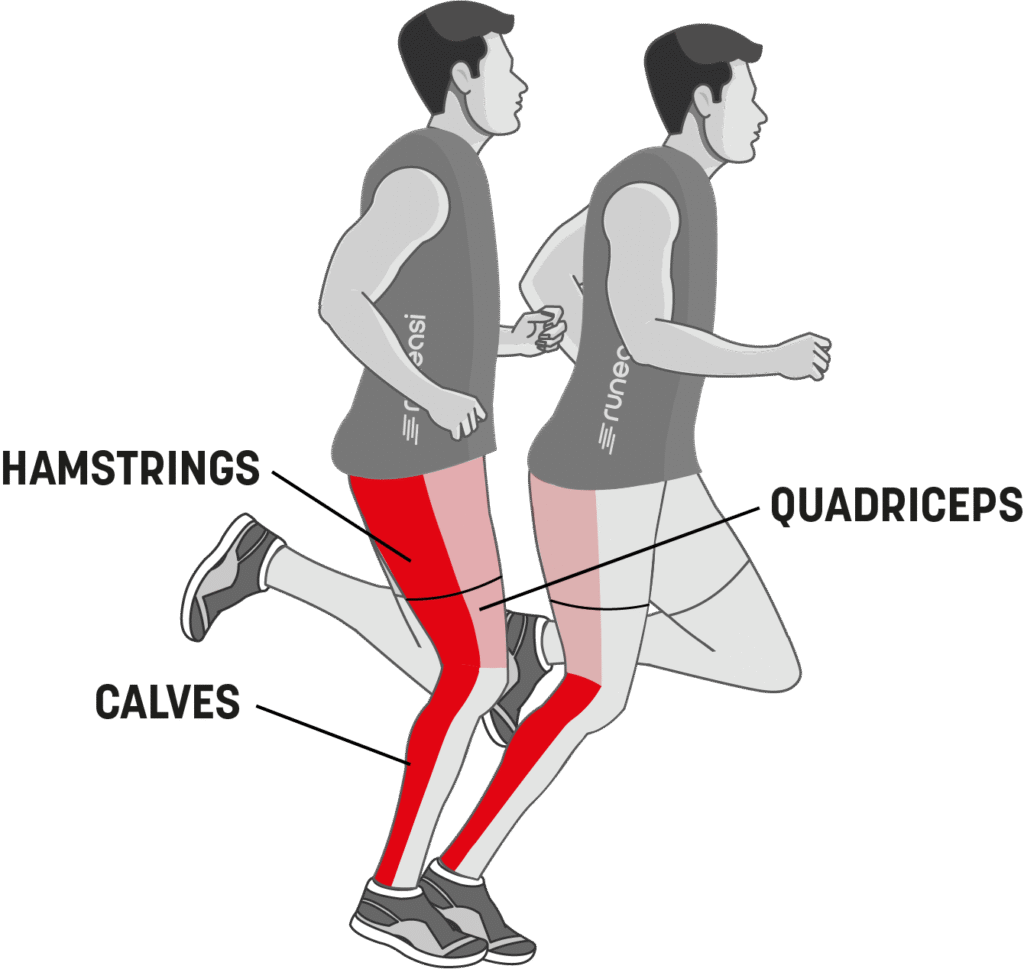
Impact loading is largely determined by the strength and coordination of the lower limb muscles (calves, hamstrings, and quadriceps) and how effectively they absorb the shock. Balanced loading and impact absorption between your left and right leg is important to avoid uneven stress on your body and potential injury.
Since running impacts occur within a (very) short time frame (± 20–130 milliseconds), your muscles must activate rapidly. Plyometric (jump) training is one of the most effective ways to develop this quick activation.
Before your body can handle the demands of plyometric training, it’s essential to first build a foundation of strength. Stronger muscles, tendons, and bones not only prepare you for explosive work but also improve resilience against the repetitive load of running. Additional focus on single-leg strength during this phase also ensures both sides of your body develop evenly.
As you develop this foundation, plyometric training should progress from low-intensity to higher-intensity jumps. This gradual approach ensures safety while maximizing adaptation. The combination of strength training and plyometric drills equips you to be stronger, more resilient, and more efficient at handling the impact forces of running.
Training plan for impact loading
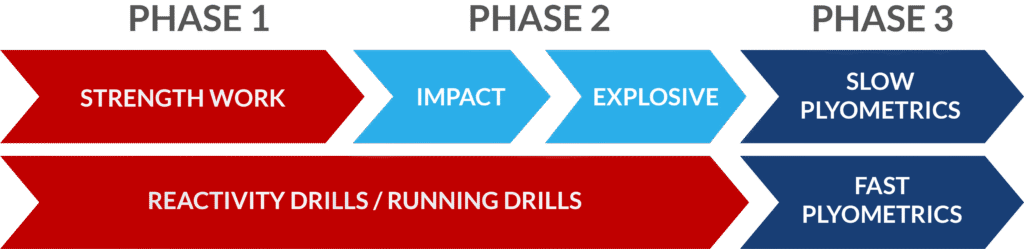
Here we provide a training plan divided into three phases, designed to help you transition smoothly from strength work to more plyometric-based training. Each phase includes three levels of example exercises that can be integrated into your program. Throughout all three phases, integrating single-leg variations helps you build symmetrical impact tolerance so that both legs can share the load efficiently with every stride.
- Goal phase 1: Prepare the body for heavier loading.
- Focus: General (single-leg) strength work combined with light-loaded plyometrics.
Exercise 1 - Flexibility warm-up
3 x 8 reps (both sides) – Rest 15 sec
Hold your back curvature while extending your leg to feel a stretch in the hamstrings.
Posterior chain flexibility exercise
4 x 20 meter – Rest 20 sec
Pull your arms upward while making a forward lunge.
Anterior chain flexibility exercise
2 x 5 reps (both sides) – Rest 15 sec
Open yourself up from an extended split position.
Anterior chain flexibility exercise
Exercise 2 - Plyo warm-up
4 x 15 sec – Rest 15 sec
Keep your feet quick and your upper body steady.
Reactivity drill
4 x 15 sec – Rest 15 sec
Keep your feet quick and your upper body steady.
Reactivity drill
4 x 15 sec – Rest 15 sec
Keep your feet quick and your upper body steady.
Reactivity drill
Exercise 3 - Posterior Strength
3 x 8 reps – Rest 45 sec (small weight 3-5kg)
Hinge your hips and maintain a slight extension in your back while lowering.
Compound (lower-limb) exercise – Posterior chain
3 x 8 reps – Rest 45 sec (small weight 3-5kg)
Hinge your hips and maintain a slight extension in your back while lowering.
Compound (lower-limb) exercise – Posterior chain
3 x 8 reps – Rest 45 sec (barbell + weights)
Hinge your hips and maintain a slight extension in your back while lowering.
Compound (lower-limb) exercise – Posterior chain
Exercise 4 - Calf Strength
4 x 15 sec hold – Rest 15 sec
Maintain your position and apply steady pressure with your big toe.
Calf strength exercise
3 x 10 reps – Rest 45 sec (add small weight 5-8kg)
Move smoothly and slowly (2 sec up, 2 sec down). Push off from the big toe.
Calf strength exercise
3 x 8 reps – Rest 45 sec (add barbell + weights)
Try to move upward without using your front leg.
Calf strength exercise
Exercise 5 - Compound strength
3 x 5 reps (each side) – Rest 45 sec
Shift your weight from one side to the other while keeping your knee straight.
Compound (lower-limb) exercise – Anterior chain
3 x 6 reps – Rest 30 sec
Try to rise slowly. Don’t swing your upper body.
Compound (lower-limb) exercise – Anterior chain
3 x 8 reps – Rest 45 sec (add barbell + weights)
Perform a squat from a stable stance.
Compound (lower-limb) exercise – Anterior chain
- Goal phase 2: Build dynamic strength and tissue resilience.
- Focus: light-loaded plyometrics and dynamic strength.
Exercise 1 - Flexibility warm-up
4 x 20 meter – Rest 20 sec
Pull your arms upward while making a forward lunge.
Anterior chain flexibility exercise
2 x 8 reps (both sides) – Rest 30 sec
Alternate straightening your legs.
Posterior chain flexibility exercise
3 x 5 reps (both sides) – Rest 30 sec
Look upward while rotating.
Trunk range of motion + posterior chain
Exercise 2 - Plyo Warm-up
4 x 15 sec – Rest 15 sec
Keep your feet quick and your upper body steady.
Reactivity drill
4 x 15 sec – Rest 15 sec
Keep your feet quick and your upper body steady.
Reactivity drill
4 x 15 sec (each side) – Rest 15 sec
Keep your feet quick and your upper body steady.
Reactivity drill
Exercise 3 - Absorption
3 x 5 reps – Rest 45 sec
Stop quickly after stepping on.
Shock exercise
3 x 5 reps – Rest 45 sec
Stop quickly after stepping off.
Shock exercise
3 x 5 reps (alternate each side) – Rest 30 sec
Drop swiftly and decelerate quickly.
Shock exercise
Exercise 4 - Posterior Strength
3 x 8 reps – Rest 45 sec (small weight 3-5kg)
Hinge your hips and maintain a slight extension in your back while lowering.
Compound (lower-limb) exercise – Posterior chain
3 x 8 reps – Rest 45 sec
Hinge your hips and maintain a slight extension in your back while lowering.
Compound (lower-limb) exercise – Posterior chain
3 x 8 reps – Rest 45 sec (barbell + weights)
Hinge your hips and maintain a slight extension in your back while lowering.
Compound (lower-limb) exercise – Posterior chain
Exercise 5 - Dynamic calf strength
3 x 8 reps (both legs) – Rest 30 sec
Hold your feet steadily.
Dynamic calf strength exercise
4 x 10m – Rest walk back
Move smoothly and slowly from heel to toe.
Dynamic calf strength exercise
4 x 10m (add 3-5kg) – Rest walk back
Move smoothly and slowly from heel to toe.
Dynamic calf strength exercise
Exercise 6 - Compound strength
3 x 6 reps – Rest 30 sec
Try to rise slowly. Don’t swing your upper body.
Compound (lower-limb) exercise – Anterior chain
3 x 8 reps (each side, add 5-8kg) – Rest 45 sec
Softly absorb the impact during the landing of your lateral lunge.
Compound (lower-limb) exercise
3 x 8 reps – Rest 1 min (add barbell + weights)
Keep your back leg relaxed on the bench.
Compound (lower-limb) exercise – Anterior chain
Exercise 7 - calf strength
3 x 10 reps – Rest 45 sec (add small weight 5-8kg)
Move smoothly and slowly (2 sec up, 2 sec down). Push off from the big toe.
Calf strength exercise
3 x 8 reps – Rest 1 min
Hold a 90° angle in your hips and knees. Move your ankle smoothly and slowly.
Calf strength exercise
3 x 8 reps – Rest 45 sec (add barbell + weights)
Try to move upward without using your front leg.
Calf strength exercise
- Goal phase 3: Maximize the ability to absorb and reuse impact forces.
- Focus: Explosive and advanced plyometric exercises.
Exercise 1 - Flexibility warm-up
4 x 20 meter – Rest 20 sec
Pull your arms upward while making a forward lunge.
Anterior chain flexibility exercise
2 x 8 reps (both sides) – Rest 30 sec
Alternate straightening your legs.
Posterior chain flexibility exercise
3 x 5 reps (both sides) – Rest 30 sec
Look upward while rotating.
Trunk range of motion + posterior chain
Exercise 2 - Dynamic calf strength
4 x 10m – Rest walk back
Move smoothly and slowly from heel to toe.
Dynamic calf strength exercise
4 x 10m (add 3-5kg) – Rest walk back
Move smoothly and slowly from heel to toe.
Dynamic calf strength exercise
4 x 10m (add 3-5kg) – Rest walk back
Drive from the big toe.
Dynamic calf strength exercise
Exercise 3 - running drill
4 x 20m – Rest walk back
Move your feet like a small rolling wheel. Keep your toes up as you move upward.
Running drill
4 x 20m – Rest walk back
Lift your knees high while maintaining an upright posture.
Running drill
3 x 20m (both sides) – Rest walk back
Lift your knee high while maintaining an upright posture.
Running drill
Exercise 4 - Plyometrics (slow)
4 x 10 sec – Rest 45 sec
Jump explosively.
Slow stretch-shortening cycle exercise
3 x 10 jumps (each side) – Rest 45 sec
Jump explosively on one leg.
Slow stretch-shortening cycle exercise
3 x 10 jumps (each side) – Rest 45 sec
Jump explosively on one leg.
Slow stretch-shortening cycle exercise
Exercise 5 - Plyometrics (Fast)
4 x 10 jumps – Rest 45 sec
Jump as quickly and high as possible.
Fast stretch-shortening cycle exercise
4 x 10 jumps – Rest 45 sec
Jump as quickly and high as possible.
Fast stretch-shortening cycle exercise
3 x 5 jumps – Rest 1 min 30 sec
Jump as high and quickly as possible.
Fast stretch-shortening cycle exercise