
Reactive strength is a key quality in sports that involve running and jumping. It reflects how quickly you can transfer force into the ground, an ability essential for high-velocity running, efficient acceleration, and rapid changes of direction.
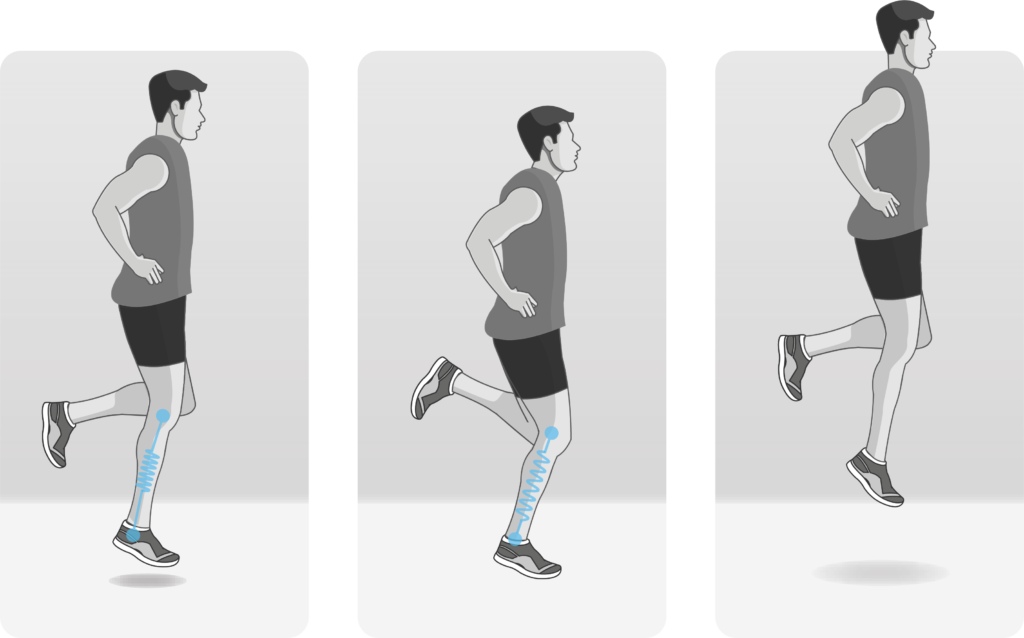
When both double-leg and single-leg reactive performance are reduced, it often reflects limitations in stretch-shortening cycle speed, foot–ankle stiffness, or neuromuscular activation efficiency. Training should therefore address both systems simultaneously: building global reactive power through double-leg plyometrics while restoring limb-specific stability and force transfer with single-leg tasks.
When single-leg reactive strength is specifically limited, often seen as longer ground-contact times, the underlying issue is commonly reduced limb stability. This creates an “energy leak” that restricts efficient force transfer. Improving pre-activation of stabilizing muscles through unilateral reactive-stability drills is key to restoring this capacity.

We provide a framework that integrates both bilateral and unilateral loading strategies. Phase 1 builds strength, stability, and tissue readiness for plyometric power exercises. Phase 2 then develops reactive strength across both double-leg and single-leg tasks through fast, elastic movements.
- Goal phase 1: Tissue readiness
- Focus: Calf/Achilles strength & absorbing capacity
- Duration: 2x/week, 4-6 weeks till next phase
Mobility warm-up
Warm-up 1 - Ankle mobility
3 sets 5 reps 5 sec hold
Push your knee a bit with your hand.
Ankle range of motion exercise
3 sets 8 reps – Rest 30 sec
Hold yourself small and move through your ankles.
Ankle range of motion exercise
3 sets 5 reps 3 sec hold
Position the belt close to your ankle joint.
Ankle range of motion exercise
warm-up 2 - Posterior chain flexibility
3 x 8 reps (both sides) – Rest 15 sec
Hold your back in a neutral position while extending your leg to feel a stretch in the hamstrings.
Posterior chain flexibility exercise
2 sets 5 reps (both sides) 5 sec hold – Rest 30 sec
Try to straighten your legs.
Posterior chain flexibility exercise
2 x 5 reps 5 sec hold – Rest 15 between each side
Extend your leg and reach to your extended toes.
Posterior chain flexibility exercise
Exercises
Exercise 1 - Calf strength
4 x 15 sec (both sides) – Rest 15 sec between each side
Hold your heel high.
Calf strength exercise
3 x 10 reps – Rest 45 sec (add small weight 5-8kg)
Move smoothly and slowly (2 sec up, 2 sec down). Push off from the big toe.
Calf strength exercise
3 x 8 reps – Rest 45 sec (add barbell + weights)
Try to move upward without using your front leg.
Calf strength exercise
Exercise 2 - Explosive / Max Strength (Squat)
3 set 8 reps (both sides) – Rest 30 sec (between sides)
Explosive up and down
Compound Lower-Limb Rebound Power
3 set 8 reps (both sides) – Rest 30 sec (between each side)
Explosive up and down
Compound Lower-Limb Rebound Power
3 set 5 reps – Rest 1 min (between each side) Explosive up, slow down
Intensity: 70 – 85% 1 Rep Max
Compound Lower-Limb Rebound Power
Exercise 4 - Braking Power
3 set 5 reps (both sides alternating) – Rest 45 sec
Drop quickly down.
Lower-limb Braking Power
3 set 5 reps (both sides alternating) – Rest 45 sec
Land softly.
Lower-limb Braking Power
3 set 5 reps (alternating both sides) – Rest 45 sec
Land softly in a lunge position
Lower-limb Braking Power
Exercise 3 - Dynamic Calf drill
3 x 8 reps (both legs) – Rest 30 sec
Hold your feet steadily.
Dynamic calf strength exercise
4 x 10m – Rest walk back
Move smoothly and slowly from heel to toe.
Dynamic calf strength exercise
4 x 10m (add 3-5kg) – Rest walk back
Move smoothly and slowly from heel to toe.
Dynamic calf strength exercise
- Goal phase 2: Reactive strength / Plyometric power
- Focus: Plyometrics
- Duration: 2x/week, 2-4 weeks
Mobility warm-up
Warm-up 1 - Ankle mobility
3 sets 5 reps 5 sec hold
Push your knee a bit with your hand.
Ankle range of motion exercise
3 sets 8 reps – Rest 30 sec
Hold yourself small and move through your ankles.
Ankle range of motion exercise
3 sets 5 reps 3 sec hold
Position the belt close to your ankle joint.
Ankle range of motion exercise
warm-up 2 - Posterior chain flexibility
3 x 8 reps (both sides) – Rest 15 sec
Hold your back in a neutral position while extending your leg to feel a stretch in the hamstrings.
Posterior chain flexibility exercise
2 sets 5 reps (both sides) 5 sec hold – Rest 30 sec
Try to straighten your legs.
Posterior chain flexibility exercise
2 x 5 reps 5 sec hold – Rest 15 between each side
Extend your leg and reach to your extended toes.
Posterior chain flexibility exercise
Exercises
Exercise 1 - Dynamic Calf drill
4 x 10m – Rest walk back
Move smoothly and slowly from heel to toe.
Dynamic calf strength exercise
4 x 10m (add 3-5kg) – Rest walk back
Move smoothly and slowly from heel to toe.
Dynamic calf strength exercise
4 x 10m (add 3-5kg) – Rest walk back
Drive from the big toe.
Dynamic calf strength exercise
Exercise 2 - Braking Power
Increase Level, velocity, or height relative to the previous phase.
3 set 5 reps (both sides alternating) – Rest 45 sec
Drop quickly down.
Lower-limb Braking Power
3 set 5 reps (both sides alternating) – Rest 45 sec
Land softly.
Lower-limb Braking Power
3 set 5 reps (alternating both sides) – Rest 45 sec
Land softly in a lunge position
Lower-limb Braking Power
Exercise 3 - Reactivity
Focus on minimizing ground contact time.
3 x 10 reps (both sides) – Rest 15 sec (between sides)
Keep your feet quick and your upper body steady.
Reactivity drill
4 x 15 sec – Rest 15 sec
Keep your feet quick and your upper body steady.
Reactivity drill
4 x 15 sec – Rest 15 sec
Keep your feet quick and your upper body steady.
Reactivity drill
Exercise 4 - Single-leg Plyometric Power
Focus on minimizing ground contact time or maximizing jump height, depending on your primary limitation.
3 sets 8 reps (both sides)- Rest 45 sec between each side
Jump as high as possible with a short contact.
Plyometric Power
3 sets 5 reps (both sides) – Rest 45 sec between each side
Jump as high as possible with a short contact.
Plyometric Power
3 sets 5 reps (both sides) – Rest 45 sec between each side
Jump as high as possible with a short contact.
Plyometric Power