
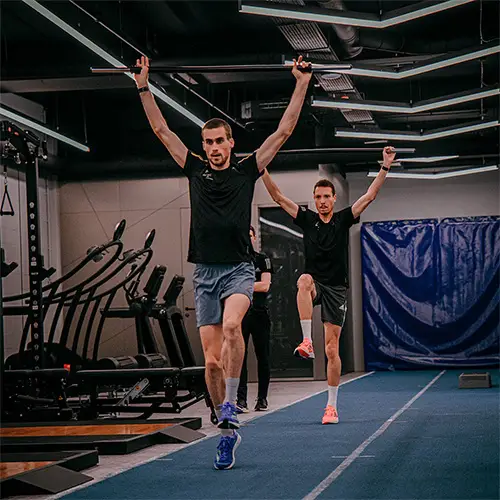
In part 2 we provided isolated and static exercises to improve the strength capacity of the stabilizing muscles, but these should not be the endpoint of your training program. While they can make your body stronger, they don’t make you run more efficiently. The next step should be training intramuscular and intermuscular coordination in faster movements, which can be trained with dynamic and reactive exercises.
2. Dynamic exercises

Dynamic exercises are the next step that emphasizes the functional training aspects of muscle groups. Although they can still improve muscle strength and endurance, the primary goal is to enhance intramuscular and intermuscular coordination between muscle groups. Quality of execution is crucial, so focus on proper technique rather than quantity. To effectively challenge the neuromuscular system, it’s crucial to vary the exercises regularly. Circuit training can be great way to keep it challenging.
However, it’s important to recognize that mastering dynamic exercises are not the endpoint. Although these exercises have higher specificity than isolated and static exercises, they still fall short of the demands of activities like running.
Example exercises
Pallof press – backward lunge to knee lift
E.g. 3 x 8 left & right R1′
This exercise has a similar target as the more static single-leg stance variant. It aims to strengthen the posterior oblique sling on the left leg in various body positions. Holding the final position for one second can serve as a useful indicator of control and execution quality.
stork swissball – 3D
E.g. 3 x 8 left & right R1′
To target the whole-lumbopelvic core strength, we can incorporate movements that increase the range of motion in the hip (squat), perform arm lifts, and include upper body rotations. By adding 3D components to our training, we can challenge our muscle fibers from different angles, making it more difficult to maintain stability.
2. Reactive exercises

As we already know from the determining factors (part 1), we must rely on muscle pre-activation, where the stabilizing muscles are already active before the foot hits the ground. By incorporating reactive exercises we train the ability to stabilize during a limited time. Focus on whole-body exercises gets priority in this type of training.
Example exercises
double skips – core tension
E.g. 5 x 20 sec R1′
This exercise focuses on the sagittal and rotational control of the abdominal muscles during reactive work. Pro tip: Try not to lean forward (hanging) & keep the tension on the elastic bands without moving.
skip & hold – loose weights
E.g. 3 x 16 jumps R1′
By incorporating loose weights we increase the unpredictability of the exercise. Only a good co-activation of the lumbopelvic muscles will improve the execution. Pro tip: hold 1 sec before going to the next jump to assess the success of the stabilizing action.
Hurdle skips + weight
E.g. 5 x 20m R30′
The hurdles require a high knee, which can help to maintain a good hip lock and pre-activation prior to ground contact. Pro tip: Increase stride length and intensity of the exercise.
Strides with stick
E.g. 3 x 60m (60-70% max) R2′
These strides won’t improve your running speed but challenge the lumbopelvic muscles that control the pelvis. Pro tip: after the submaximal strides with the stick, do some harder strides (80-90%) to initiate a transfer.

Written by Philip Cortvriendt
Philip achieved a master’s degree in physiotherapy & rehabilitation sciences and has core expertise in the field of running, working with both recreational and elite runners. Philip has the unique role of educating Runeasi physiotherapists and helping them translate biomechanical insights into targeted strength and conditioning exercises- specifically on how they can improve their client care using scientifically validated biomechanical insights from our Runeasi analytics.