
Running During and following pregnancy
The pregnancy journey brings with it a myriad of emotions, experiences, and challenges for women. Amidst the excitement and anticipation of motherhood, questions often arise about maintaining a healthy lifestyle, particularly when it comes to physical activity. For many expectant and new mothers, the fear of movement, especially when it involves high-impact activities like running, can be a significant roadblock in staying active during pregnancy.
Pelvic health plays a crucial role in the well-being of women during and after pregnancy, and it is vital to address their concerns and uncertainties with confidence and competence. Unfortunately, existing healthcare guidelines often fail to provide precise guidance tailored to individual situations, leaving pregnant women unsure about the safety and benefits of engaging in physical activities.
In this post, we’ll delve deeper into a groundbreaking research study conducted by Marion Raballand. The study revolves around the intriguing relationship between wearing an abdominal belt, running technique, and pelvic loading.
"Runeasi helps me guide moms returning postpartum, to make this return to impact more reassuring and objective"—Marion Raballand, PT, PhD Student
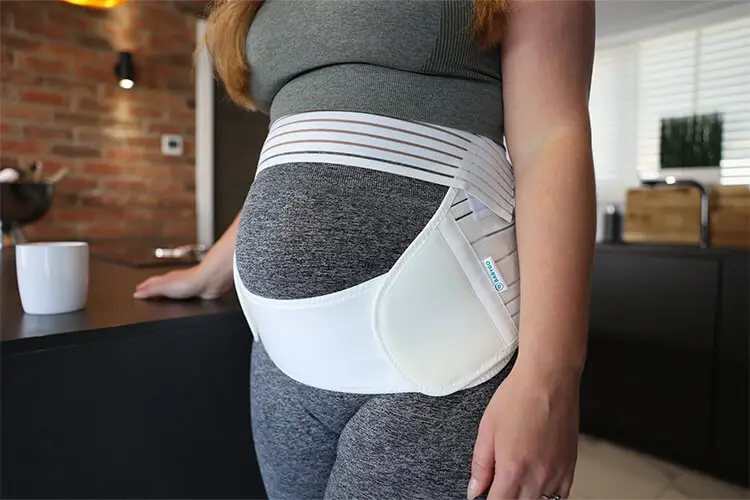
What is an abdominal belt?
An abdominal support belt for pregnant running is a specialized garment designed to provide gentle compression and support to the growing belly and lower back during physical activities like running while pregnant. The primary purpose of this belt is to alleviate the strain on the abdominal muscles and pelvic area, promoting better pelvic health and minimizing discomfort that can arise during pregnancy.
How can it improve running technique during pregnancy?
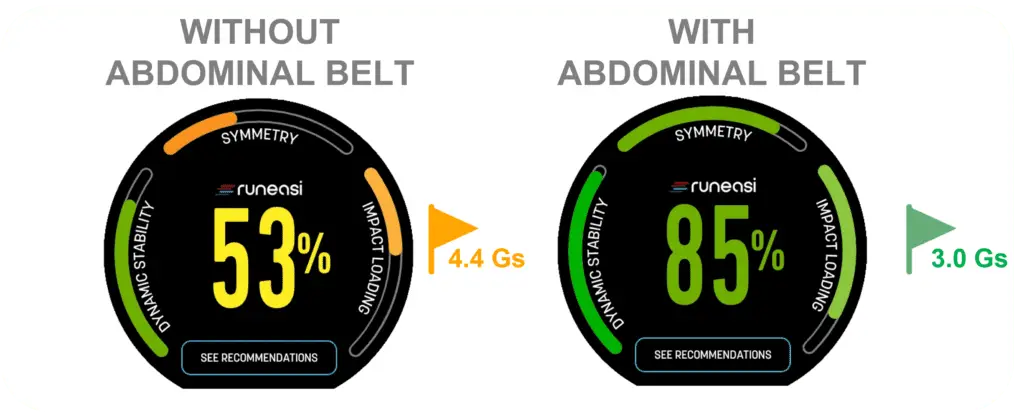
Here are some key insights observed while using the abdominal belt during running. Notably, it led to significant improvements in various aspects. Her impact was enhanced, along with her pelvic side-to-side stability and overall symmetry. Remarkably, her running quality surged from a score of 53 to an impressive 85!
Moreover, the abdominal belt proved effective in reducing pelvic discomfort, which is supported by solid data validating her subjective experience.
These positive outcomes have notably boosted her confidence in movement, a finding that resonates with other mothers as well.
For a comprehensive understanding, you can access the full abstract from Marion Raballand’s Ph.D. research conducted at UC Louvain University.”
“Aim of the study: To determine if the use of an abdominal support belt and a 10% increased cadence, separately and together, can improve the impact magnitude and duration, the pelvic instability, and the abdominal discomfort during walking and running in pregnant women.
Methods: 14 women participated to the walking protocol and 12 to the running protocol. The experiment consisted in an appointment where women had to run or walk on a treadmill under different conditions: with abdominal belt and spontaneous cadence, with abdominal belt and 10% increased cadence, without belt and spontaneous cadence and without belt and 10% increased cadence. Collected data were abdominal discomfort, impact magnitude and duration and pelvis instability.
Results: In running, the impact magnitude, impact duration and pelvis instability are significantly improved while wearing a belt. The increased cadence significantly increases the impact magnitude. In walking, discomfort and pelvis instability are significantly improved with the belt. However, the increased cadence does not bring any change.
Conclusion: Our results are encouraging because the abdominal belt improves the values and decreases discomfort, which may encourage running and walking during pregnancy. On the other hand, increasing cadence did not show any effect in our study, but it would be interesting to deepen the research to see the long-term effects of it.”

Case insight provided by: Marion Raballand, PT, PhD Candidate
Marion is an expert in perinatality and abdomino-pelvic health in women's running. Her clinical activity at MoveMum is centered, among other things, on pre and post natal physiotherapy. She tries to make pregnant women and health professionals aware of the importance of maintaining regular physical activity during pregnancy. She is also a doctoral student in motricity sciences and her research focuses on the interest of sport during pregnancy (Free University of Brussels, Belgium). In addition, Marion specializes in the management of sports pathologies related to running.
She began her career as a physiotherapist in 2009. After an experience at the Belgian French-speaking athletics league (LBFA), she joined the sports medicine branch of the Saint-Luc clinics in 2011, before becoming co-founder of the Wolu Sport Clinic. Marion is involved in several continuing education courses at Parnasse-ISEI (Brussels, Belgium) and at the Catholic University of Louvain (Brussels, Belgium).
Finally, Marion practices running with passion and even more so since she became a mother. This practice is deeply rooted in his family and professional life. She is one of the best runners in the Brussels region.
Start assessing pre and post partum running.
Speak to a member of our Runeasi team, and learn how Runeasi can improve your client outcomes in making return to impact more objective and reassuring.
If you already have a full picture of Runeasi, go for a 15min call to quickly chat about the possible next steps. Do you want to go more in detail and learn about our parameters, schedule a 45 min demo.