
Overcoming marathon stress fractures—Dr. Bart Dingenen

Breaking a personal best marathon time while being a mother of two and a having stress fracture.
 
That sounds impossible, right? Nope.  Leentje Hellemans did it!
 
Leentje is a mother of two who started running five years ago. She had already two marathons under her belt, with one being a silver medal of 3 hours 9min!
 
Unfortunately, during to covid-lockdowns she suffered from her second consecutive stress fracture. She couldn’t visit her physiotherapist, Bart Dingenen Ph.D. often enough. She couldn’t work on her running technique and exercises. 
 
After the lockdowns, she returned to her physical therapy. Bart introduced Runeasi to her marathon preparation to help her run injury free.
 
Watch the video below about her struggles and comeback success story. It’s interesting, from both a runner and physio perspective:

“Now we're always testing a cues before recommending it" - Bart Dingenen, PhD
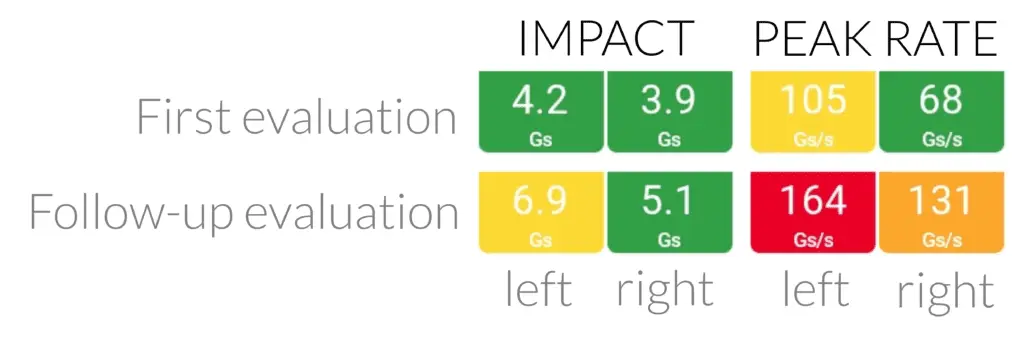
How was her first evaluation of her running gait analysis, with biofeedback? Leentje ran for 1-2 minutes at two speeds, one slower (13km/hr) and one faster (18km/hr).  The Runeasi sensor and APP recorded her impacts from her left and right legs at each speed.
 
Impact shock waves travel through the leg immediately after the foot lands. Kinetic metrics are important to give a clearer view of how large (impact) and how fast (peak rate) this occurs.
 
At a slower speed, the biofeedback APP display revealed that she was in the impact yellow zone! In the words of the patient, Leentje: “It feels good to know how much impact I have while running. It was surprising to see the imbalance between my left and right legs”.
 
At the higher speed, her peak rates were very high for both legs. Bart immediately tried several running technique cues to reduce her peak rates. He also observed that she didn’t have her own running shoes that she runs in which was playing a role in her high impact.

“Runeasi technology is a real added value to my clinical reasoning”

Follow-up evaluation: running gait analysis in the real-world.

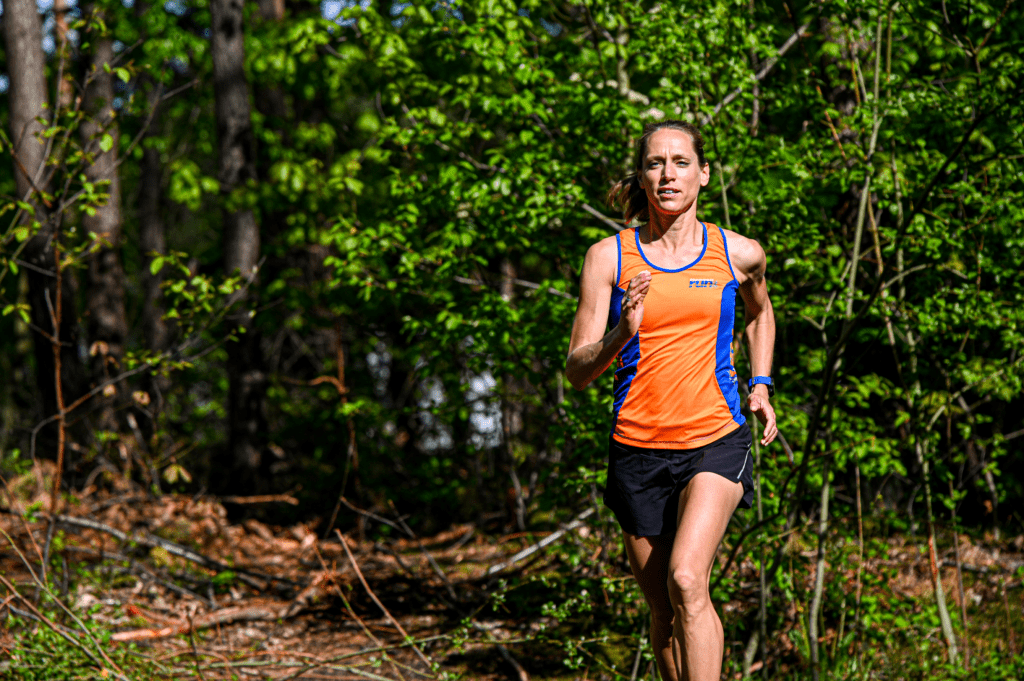
One week later Leentje returned to Motion to Balance Sports Clinic for an outdoor run. This time she brought her normal running shoes. She ran an easy pace in the forest alongside the physiotherapy practice. 
 
Bart attached her Runeasi belt, hit record, and Leentje was off running down the trail in a couple of seconds. She returned after a few minutes of running. And together they analyzed her biomechanics. 
 
Take note, if you run a clinic with a small space or without a treadmill. This is an engaging and fun way to assess your client’s running gait outdoors.
 
The most striking differences in outdoor running were:
 
1. The reduction in impact by 39% in her left leg and 23% in her right leg;
2. The reduction in peak rates by 35% in her left leg and 48% in her right leg.
 
These results indicate that her ability to absorb impact shocks was sensitive to the type of surface terrain she runs on and the type of shoes she runs in (and probably an interaction of the two!).
 
As Leentje progresses with her marathon training loads she will need to find a balance. She will need to balance the load capacity of her body’s structures with the actual load on her body.
 
Her history of stress fractures suggests that finding this balance is not easy. She needed professional guidance from a physiotherapist. She needed a physiotherapist with good clinical reasoning and supporting technology.
 
Knowing how her body responds to that impact will help her progress more competently and confidently. Especially at the most critical moments during her marathon training plan. Knowing when to push and when to rest is a key insight to avoiding an overuse injury.
 
With covid-lockdowns a thing of the past, she can work on these aspects with Bart with regular follow-up examinations.
 
We wish Leentje the best of luck!

"iT SEEMS IMPOSSIBLE UNTIL IT IS DONE" - NELSON MANDELA

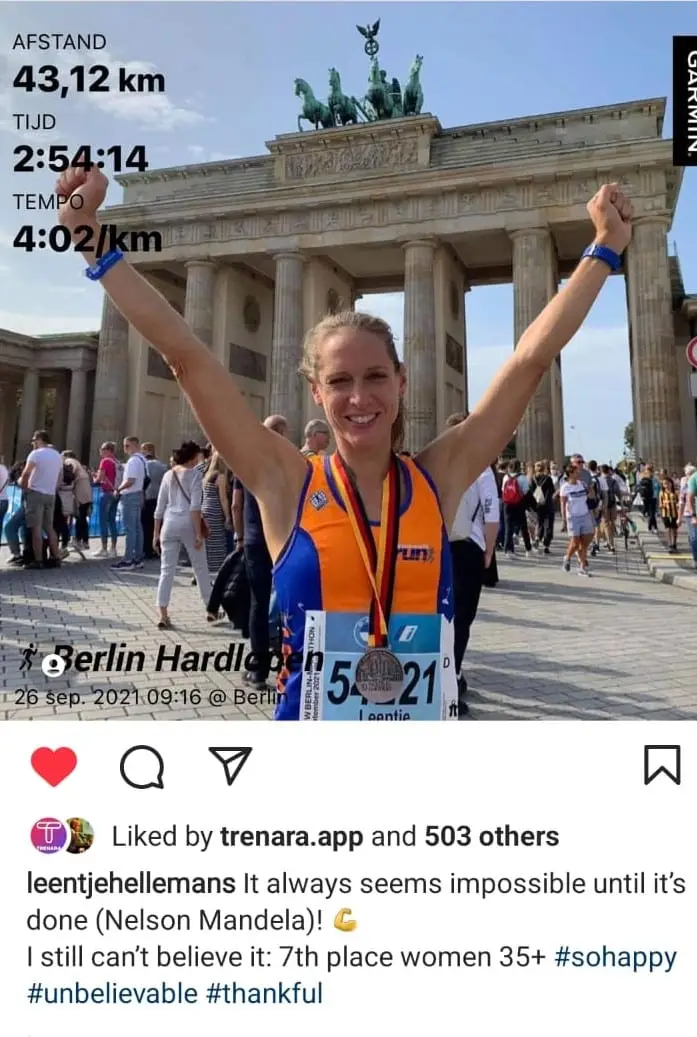
UPDATE: We are delighted to announce that Leentje has achieved her goal to run the Berlin marathon in under 3 hours injury free!

In fact, she achieved a time of 2 hours, 54 minutes, and 14 seconds. Moreover, she placed 7th overall in the women’s 35+ category! She has demonstrated incredible grit, perseverance, and willpower.

Congratulations to her and Bart for this incredible journey and success! 
Picture of Case insight provided by: Bart Dingenen, Ph.D.

Case insight provided by: Bart Dingenen, Ph.D.

Bio: I work as a physical therapist at the private clincial practice Motion to Balance, Genk, Belgium. Within this multidisciplinary setting, I mainly work with athletes in function of sports-related lower extremity injury prevention and rehabilitation. Together with 4 other colleagues, I am co-associate in this private practice.

As a clinician, I am always eager to improve myself day by day and to deliver state-of-the-art patient care. Good is never good enough. Excellence is only the result of trying to become better and better. To reach these goals, I am continuously learning from my experiences with my patients, reading novel literature and following courses of international experts in the field.
Share

Runeasi is an AI-driven, wearable 3D gait analysis technology designed to optimize running performance and reduce injury risk for athletes of all levels.

Share

Table of Contents

Interested in Runeasi?

Learn more about how
our sensor can help!